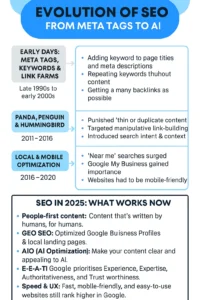
The Premature Days of SEO: Keywords, Meta Tags & Link Farms
In the late 1990s and early 2000s, SEO was relatively simple. If you wanted to rank on Google or Yahoo, all you had to do was:
- Add keywords to your page title and meta description
- Repeat the same keywords throughout your content
- Build as many backlinks as possible (even if they were low quality)
It worked — for a while. But the search results were often spammy, and users were getting frustrated.
Google Gets Smarter: Panda, Penguin & Hummingbird
Between 2011 and 2016, Google launched a series of major updates that reshaped how SEO worked:
- Panda (2011) punished thin, duplicate, or low-quality content
- Penguin (2012) targeted manipulative link-building tactics
- Hummingbird (2013) introduced semantic search, helping Google understand search intent, not just keywords
This was a turning point. SEO professionals had to stop trying to “trick” the algorithm and focus on creating genuinely helpful, high-quality content.
Tip: If your content doesn’t solve a real problem or answer a clear question, it won’t rank, no matter how well-optimised it is.
3. Mobile, Local & Voice Search Take Over
As mobile usage exploded, Google introduced mobile-first indexing, prioritising mobile-friendly sites in its rankings.
At the same time, local SEO became essential. Google Maps listings, location-specific landing pages, and “near me” searches started driving serious traffic, especially for trades, hospitality, and service-based businesses.
By 2020:
- Voice assistants like Alexa and Siri were changing how people searched
- Local packs (Google Maps 3-packs) became prime real estate in search results
- Businesses with optimised Google Business Profiles had a clear advantage
GEO SEO — the practice of targeting specific towns, cities, or regions — is now a core part of any successful SEO strategy.
4. The Rise of AI in SEO
From 2020 onwards, artificial intelligence started playing a bigger role in how Google ranks content. Technologies like RankBrain and BERT helped Google understand natural language and context more effectively.
In 2023, Google introduced the Search Generative Experience (SGE) — an AI-powered feature that provides quick answers at the top of search results, pulling content from multiple websites.
That means users are sometimes getting answers without clicking through, and your website has to work harder to earn that click.
5. SEO in 2025: What’s Working Now
Search engine optimisation in 2025 is no longer just about keywords and links. The top-performing websites have one thing in common: they’re genuinely useful.
Here’s what’s working right now:
- People-first content
Content that’s written by humans, for humans. Avoid generic, AI-written fluff. Share experience, insights, and real-life examples.
- GEO SEO
Local landing pages, optimised service areas, and up-to-date Google Business Profiles help you win in your target location.
- AIO (AI Optimisation)
Make your content easy for search engines and AI assistants to understand. Use clear headings, FAQs, structured data (schema), and factually accurate information.
- E-E-A-T
Google looks for signs of Experience, Expertise, Authoritativeness, and Trustworthiness — especially on sensitive topics like finance, health, and legal advice.
- Speed, UX & Core Web Vitals
Fast, stable, and mobile-friendly websites rank better and convert better. Poor user experience is now a ranking risk.
Final Thoughts
The SEO landscape will keep evolving, but one thing remains the same: search engines want to give users the best possible answers.
If your content is useful, relevant, and easy to access — across devices, regions, and formats — you’re setting yourself up to succeed.
Whether you’re a small local business or a growing national brand, now’s the time to audit your SEO strategy and make sure it’s future-proof.
Need help improving your rankings?
At Mind Fuse Media, we specialise in data-driven SEO that delivers results locally and nationally.
 Request a free SEO review and let’s see how we can grow your visibility.